Every number in the product traces back to individual answers. AI Responses is where those answers live, in full, exactly as the engine produced them.
If you only learn one screen, learn this one. Fifteen minutes reading real answers builds more intuition about your AI visibility than any dashboard.
The list
Open Visibility Hub → AI Responses:
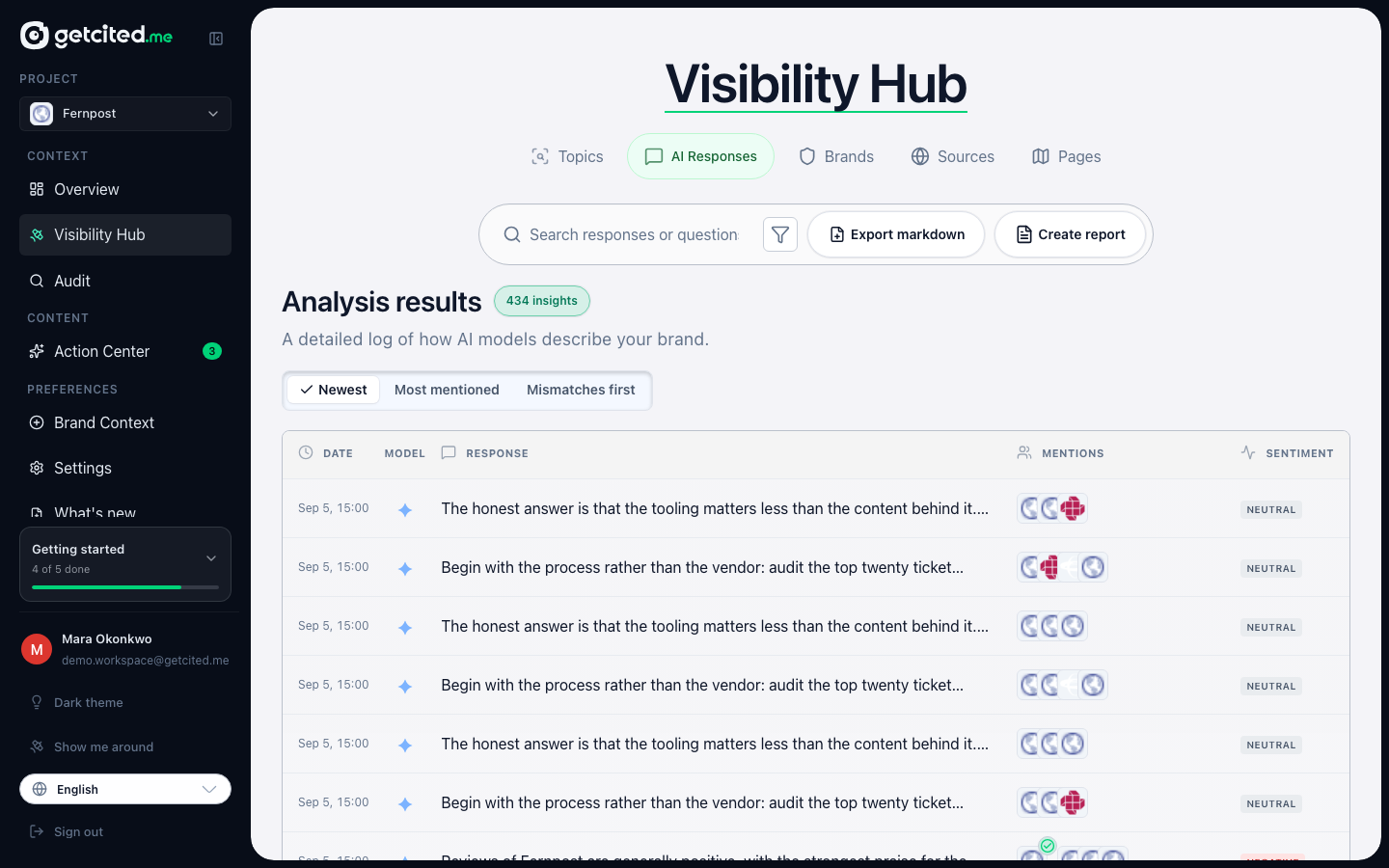
Each row is one real answer from one engine to one of your questions. The columns tell you which question was asked, which engine answered, what type the question was, and the verdict on your brand.
With a few hundred answers the list gets long, so the toolbar filters it:
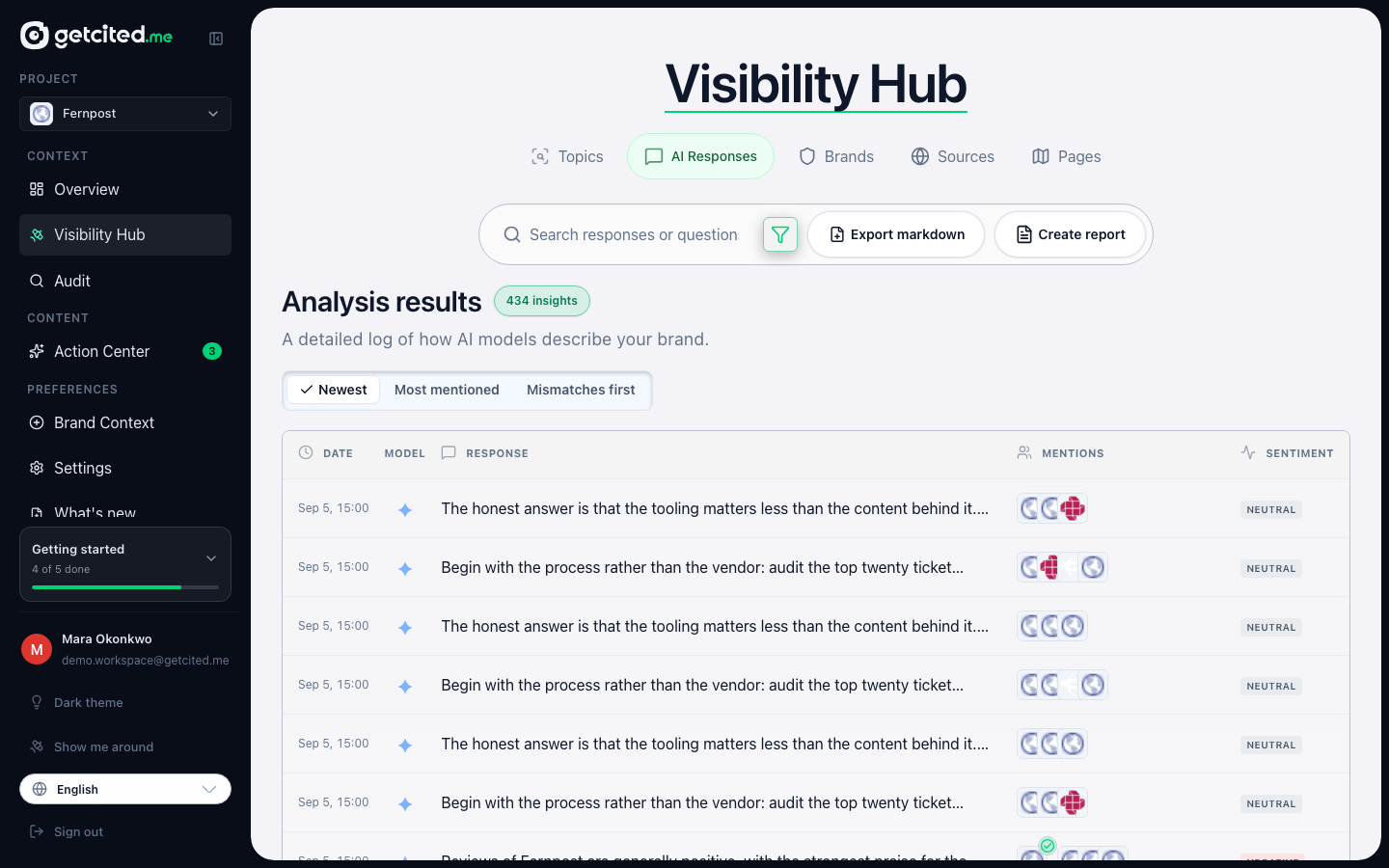
Two filters earn their keep immediately:
- Verdict = Not mentioned, type = Organic. This is your gap list: the questions where a customer described your problem and the model recommended somebody else.
- Sort by mismatches first. These are the cases where the model thinks it is talking about you, and is not.
The three verdicts
Verified
Your brand was named in the answer and the answer points at your actual domain. This is the only verdict that counts toward your visibility number.
Not mentioned
Your brand did not appear. Nothing subtle here — but do open a few of them anyway, because the useful information is who was named instead.
Mismatch
The model appeared to mention you, but the mention did not survive verification. This exists because brand names are not unique, and a mention of a company that shares your name is worth nothing to you.
There are three distinct reasons an answer is marked Mismatch, and the modal states which one applies:
- "The answer points at a look-alike site." The name matched, the domain did not. Another company with a similar name got the credit.
- "The brand name does not actually appear in the answer." The model referred to something that resembled your brand without ever naming it.
- "Named in this comparison, but the answer never cites your domain." In a head-to-head, being named without being pointed at is not a verified mention.
We deliberately do not soften this rule. A partial or ambiguous mention is not counted, because a number that inflates itself with mentions of a different company is worse than no number.
If you see repeated look-alike mismatches, that is a real, fixable finding — it means the models are conflating you with another entity. Action Center has a dedicated flow for exactly that case.
Inside one answer
Open a row and you get the full picture: the complete answer text, the verdict with its reason, the sentiment, your position in the answer, and the sources the engine cited.
Three things to look at every time:
- Where you appear. Being named in the first sentence and being named in a footnote are very different outcomes with the same verdict.
- How you are described. The sentiment tag is a summary; the wording is the substance. Models repeat framing they found on other sites — if the description is wrong, somewhere on the web is telling them so.
- What was cited. This is the actionable part.
Sources: where answers come from
Engines build answers out of sources, and they reuse the same ones relentlessly. The Sources tab aggregates them:
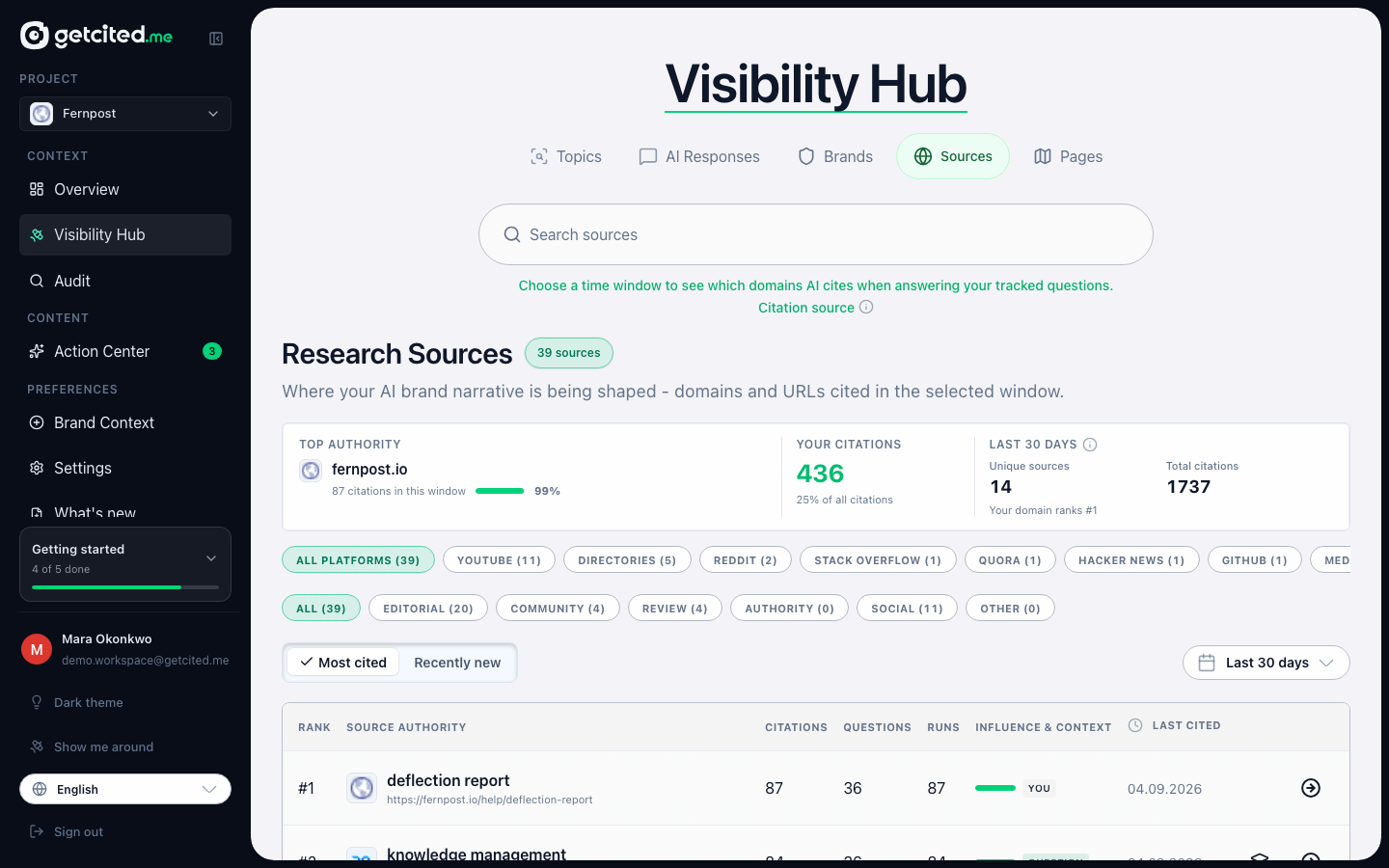
Read it as a list of gatekeepers. If the same review site, directory or community thread is cited across most answers in your category, then your presence — or absence — on those pages is doing more work than your own website.
This is usually the shortest path to moving the organic bar: not writing more pages on your own domain, but appearing credibly on the sources the models already trust.
A repeatable weekly routine
- Filter to Organic + Not mentioned. Read five answers. Write down which brands were recommended instead.
- Sort by mismatches first. If look-alikes appear, note the confusing entity.
- Open Sources and pick the highest-frequency domain you are absent from.
- Take one of those three findings into Action Center and act on it.
Four steps, twenty minutes, once a week. That is the whole discipline.
Common questions
Why do two engines answer the same question differently?
Because they are different models with different training and different source weighting. Disagreement between engines is normal and informative — it usually means your position in that category is unstable rather than settled.
An answer names me but the verdict says Mismatch. Is that a bug?
Almost certainly not — open it and read the reason line. In nearly every case the answer points at a different company's domain, or names something that only resembles your brand.
Can I export answers?
Sharing is available through report links; see Settings for client reports.
What to read next
- Competitors and brands — turning "who was named instead" into tracked rivals.
- Action Center — what to do with the gaps you just found.
Definitions live in the glossary: brand mention, entity disambiguation, citation source.