Every time an engine answers one of your questions, it names brands. We record all of them — not just yours. That record is the most honest competitive map you will get, because it is built from the answers customers actually receive rather than from a market report.
Detected brands vs saved competitors
Two different things live on the Brands screen, and the difference matters.
Detected brands are every company name that appeared in your tracked answers. They arrive automatically. Some are genuine rivals, some are adjacent tools, some are irrelevant — a magazine, a marketplace, a company that happens to share a word with your category.
Saved competitors are the ones you explicitly marked. Only these are treated as your competitive set for comparisons, and only these are added by you — nothing is promoted automatically.
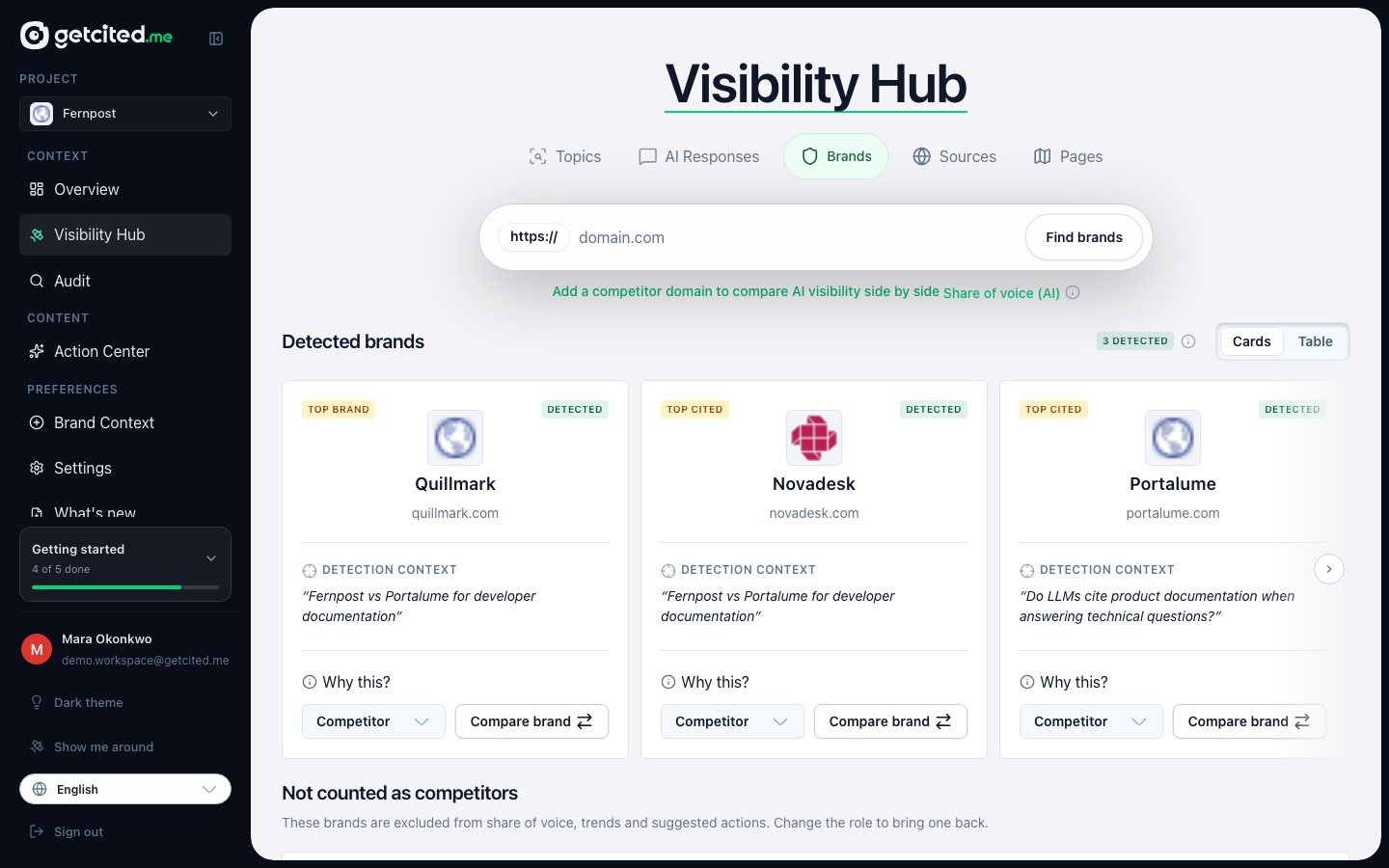
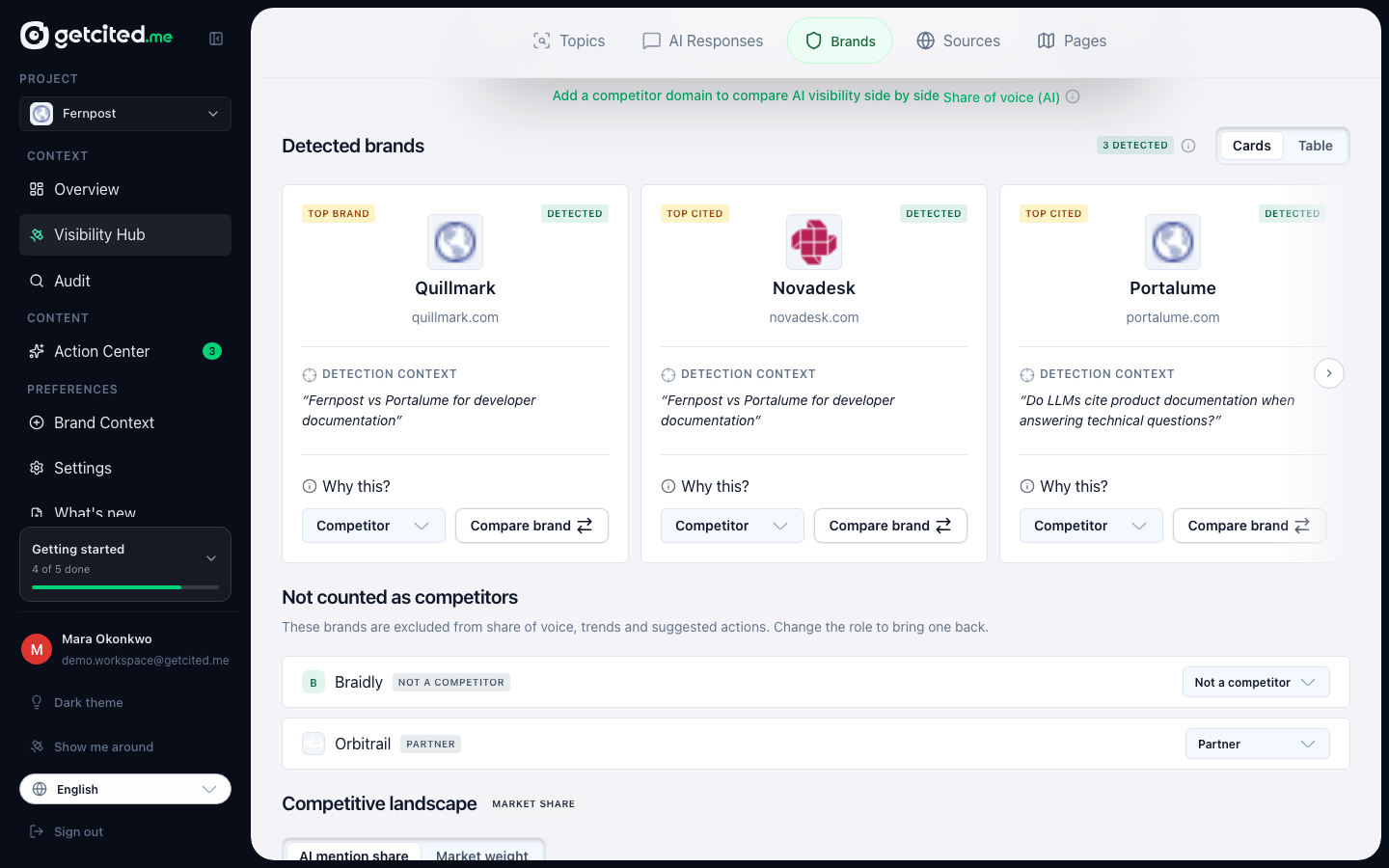
Saving a competitor is a judgement, not data entry. Save the ones you actually lose deals to.
How to read the table
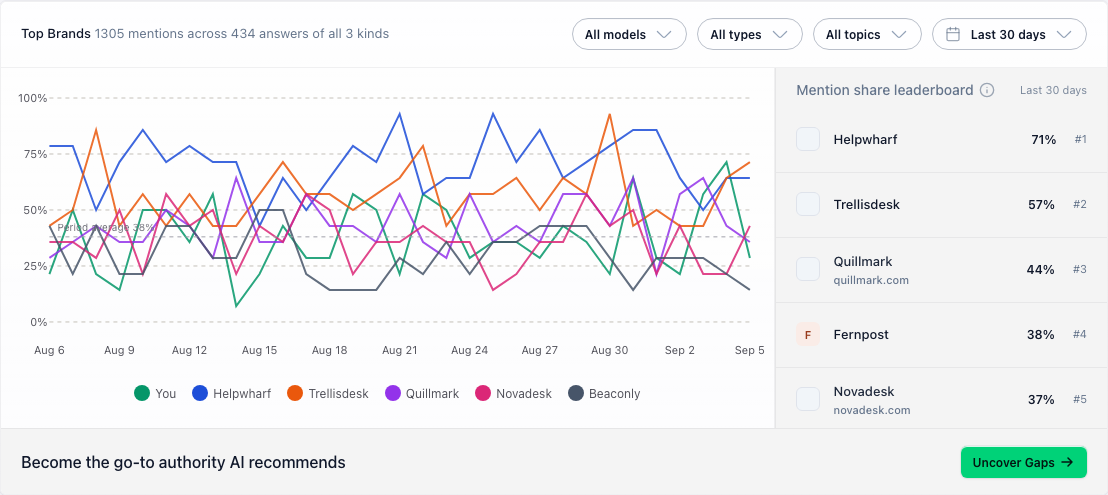
The table ranks brands by how often they were named across your tracked answers.
- Mentions — how many answers named that brand.
- Share — that brand's slice of all brand mentions in your set.
- Role — competitor, unrelated, or not yet classified.
Two habits make this screen useful:
Look up, not at yourself. The rows above you are the answers your customers are being given. Read a few of the answers where those brands were recommended and yours was not — that comparison is the whole point of the screen.
Correct the roles. A brand marked as a competitor that is not one skews your comparisons. Marking it unrelated takes a second and makes every later number cleaner.
Where a name comes from
Any brand in the table can be traced back. Filter AI Responses by that name and you see every answer it appeared in, in what context, and which sources backed it. That usually explains the ranking faster than any aggregate: a brand that dominates your category is normally being cited from three or four specific sources, and you can go and look at them.
When a rival appears from nowhere
New names in the table are worth attention. Because assistants build answers from sources rather than from market share, brands that are invisible in classic search rankings routinely appear in AI answers — usually because they are well described somewhere the model trusts.
If a name you have never heard of is being recommended in your category, that is not noise. It is a preview of where your market is moving.
Comparison questions
Detected brands and saved competitors feed comparison questions — the "you vs them" type described in Questions, topics and answer credits.
A comparison question is worth tracking when you genuinely meet that rival in deals. Tracking comparisons against a brand nobody weighs you against burns credits and teaches nothing.
One caution when reading comparison results: being named in a comparison is not the same as winning it. The verdict tells you whether the mention was verified; the answer text tells you whether the recommendation actually landed on you. Read the text.
When the model confuses you with someone else
If a rival's mentions look implausibly high, check for a name collision. Two companies with similar names in adjacent categories are common, and models conflate them. Answers where that happens are marked as mismatches — see Reading your AI answers for how those verdicts work and what to do about them.
Common questions
Do detected brands count against my visibility number?
No. Your number is your own mention rate. Other brands provide context, not arithmetic.
Can I remove a detected brand?
You can mark it unrelated so it stops being treated as a competitor. The underlying mentions stay, because they really did occur.
How many competitors should I save?
Few. Three to five real rivals produce sharper comparisons than fifteen loosely related names.
What to read next
- Reading your AI answers — the evidence behind every row here.
- Action Center — turning a competitive gap into work.
Definitions live in the glossary: competitor tracking, share of voice, entity disambiguation.