A question is one thing a customer might ask an AI assistant. Questions are what we actually track: each one is sent to the engines on a schedule, and every answer is read and recorded.
This guide covers what makes a good question, how to add more, and how answer credits are spent — the one part of the product that costs you something, so it is worth understanding before you spend it.
Questions live inside topic clusters
A cluster is a small group of questions around one buying intent. Grouping matters because a single question is noise: one answer that omits you means nothing, while eight of ten answers in the same cluster omitting you is a finding.
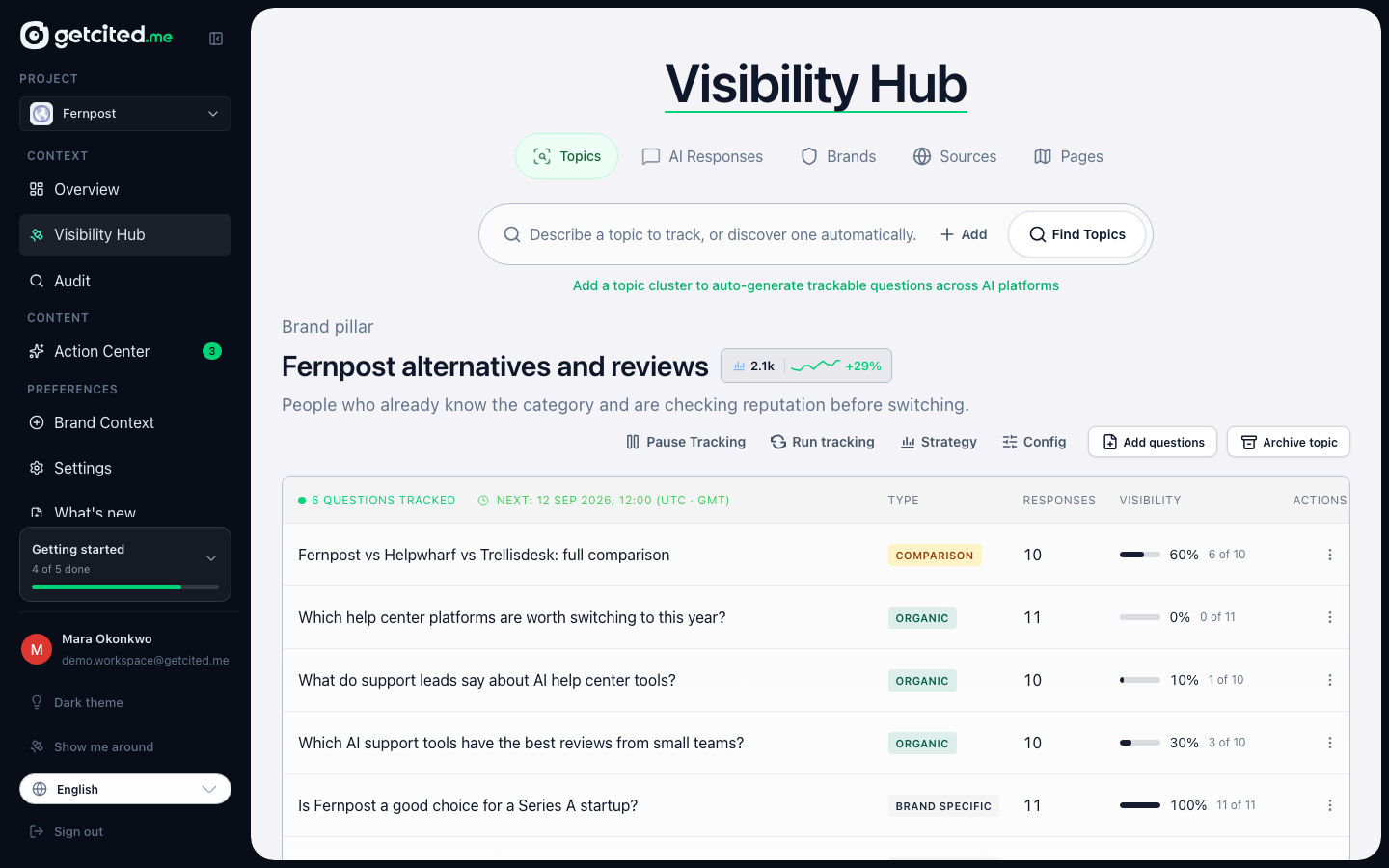
Each cluster shows how many questions it holds, how often you are mentioned across them, and when it last ran.
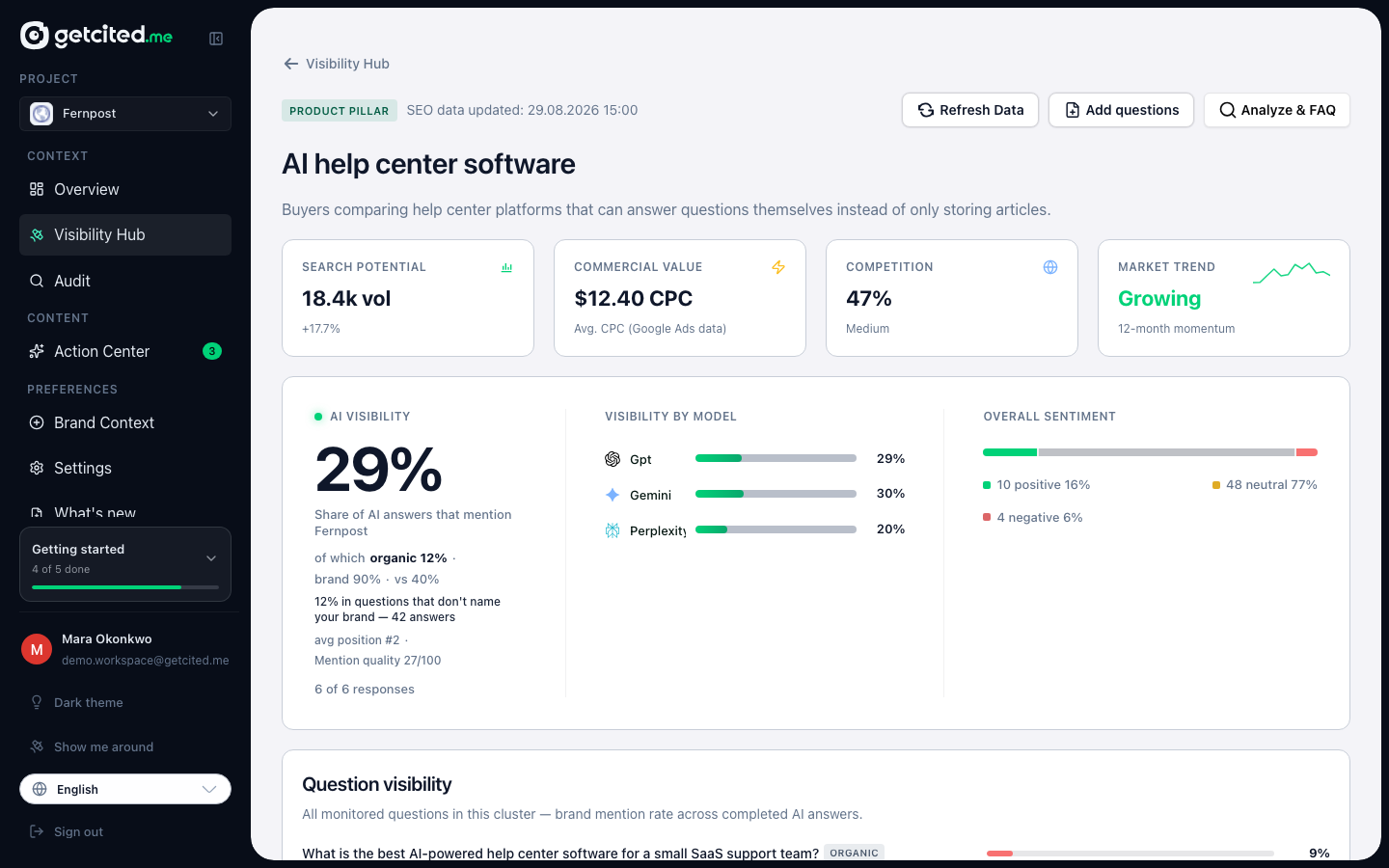
The three question types
Every question is one of three types, and the type decides what a result tells you.
| Type | What it looks like | What it tells you |
|---|---|---|
| Organic | "What should I use to…" | Whether you get recommended on merit |
| Comparison | "Acme vs Globex" | Whether you survive a head-to-head |
| Brand | "What is Acme?" | Whether the model knows you at all |
We keep them separate everywhere in the product. Averaging them hides the one result that matters: a strong brand rate will always mask a weak organic rate.
Where your first questions came from
During onboarding we read your site, worked out what you sell and to whom, and generated a first cluster from that. You saw the list and could edit it before signing up — nothing was tracked without your approval.
That first set is a starting point, not a final answer. It is built from what your site says about itself, which is not always what customers actually ask.
Adding more questions
Open Visibility Hub → Topics. You have three ways to grow the set:
- Generate a cluster. Describe an area — a use case, an audience, a competitor set — and we propose a title, an intent and a set of questions. The new cluster arrives as a draft: it carries an Awaiting your confirmation badge, its Run tracking button is locked, and until you press Confirm nothing is tracked, nothing is scheduled and no answer credit is spent. Reviewing ten questions once is cheaper than discovering a month later that half of them were never about your business.
- Add a question by hand to an existing cluster, when you know the exact phrasing you care about.
- Remove questions that are not earning their credits.
What makes a good question
The test is simple: would you genuinely expect to be a valid answer?
- "Best CRM" — a lottery. The model names the three largest incumbents every time, and you learn nothing.
- "CRM for a two-person recruiting agency" — a question you can actually win, and losing it tells you something specific.
Three habits that pay off:
- Write how customers talk, not how you market. Nobody asks for an "AI-powered visibility platform".
- Include the constraint. Budget, team size, industry, integration — constraints are where smaller brands win.
- Add the question you are afraid of. The comparison against your strongest rival is worth more than five safe questions.
How answer credits are spent
One tracked answer from one engine costs credits. Engines cost different amounts because they cost us different amounts to run:
| Engine | Credits per answer |
|---|---|
| Gemini | 1 |
| Google AI Overview | 1 |
| Perplexity | 2 |
| ChatGPT | 3 |
| Claude | 6 |
A cluster of ten questions checked on Gemini spends ten credits. The same ten on Claude spend sixty.
Plan allowances:
- Free — 100 credits, once. Not monthly.
- Growth — 2,000 credits per month.
- Scale — 6,000 credits per month.
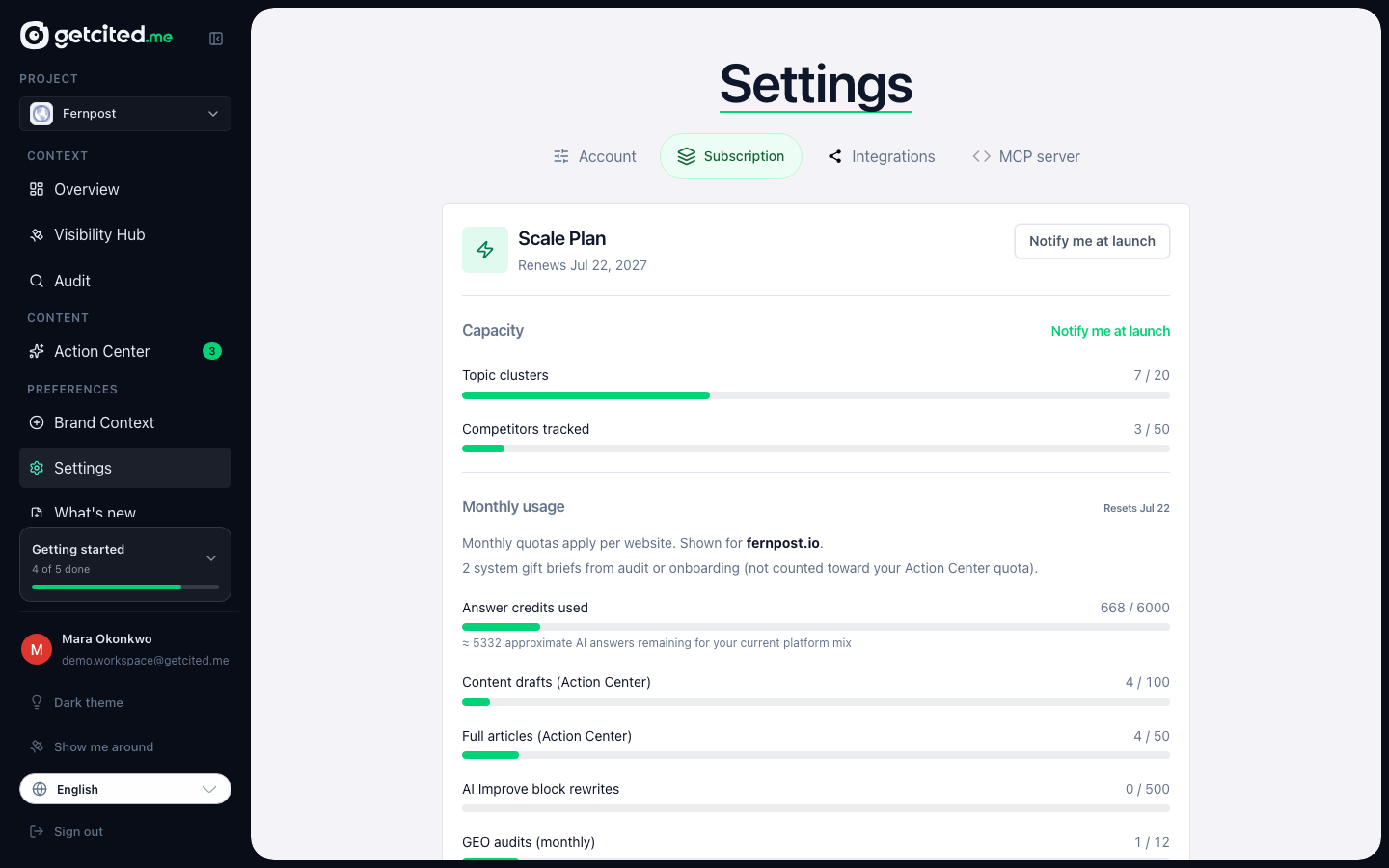
Usage is shown in Settings. When credits run out tracking stops rather than silently billing you — nothing is charged without you choosing a plan.
Spending credits well
The instinct is to check every question on every engine. That is usually the wrong trade.
- Go wide on a cheap engine first. A broad set of organic questions on Gemini finds your gaps for a fraction of the cost.
- Spend the expensive engines narrowly. Put ChatGPT and Claude on the handful of questions that decide deals.
- Only pay for multiple engines when you have evidence they disagree. Sometimes they do, and that is worth knowing — but confirm it on a few questions before you multiply your whole set by five.
Common questions
How often are questions re-run?
On a recurring schedule per cluster. You do not need to trigger runs by hand; the cluster shows when it last ran.
Can I track questions in another language?
Questions are tracked as written, so a question written in another language is answered in that language. Bear in mind that the brand-matching rules and your brand profile are strongest in the language your site is written in.
What happens if I delete a question?
Its historical answers stay — your past numbers do not change retroactively. It simply stops being asked from now on.
Why does one cluster have far more answers than another?
Answers accumulate per question per engine over time. A cluster added last week has had fewer runs than one that has been tracked since sign-up.
What to read next
- Adding a topic and confirming its questions — the draft gate in full: what the proposal shows and why nothing runs until you confirm.
- Reading your AI answers — what to do with the results these questions produce.
- What your visibility number means — how the answers roll up into one figure.
Definitions live in the glossary: topic cluster, prompt tracking, brand mention.