Overview tells you how often AI engines name your brand. Pages answers the other half of that question: when an engine goes looking for something to quote, is any page of yours worth quoting?
It sits in Visibility Hub, next to AI Responses and Sources. Everything on it is about your own site.
Why a good page can still be invisible
A person reads your page in a browser. Styles are applied, scripts have run, images have loaded, and the layout is doing half the explaining.
An answer engine reads the HTML your server returns, and looks for something it can lift out: a sentence that answers the question on its own, a marked-up section, a table, a document with a date on it.
Those are two different jobs. A page can be persuasive, well designed and commercially successful and still hand an engine nothing liftable — an opening line that is a slogan, headings that are only styled text, no schema, no date, and the substance spread across three paragraphs of narrative. It reads well. There is nothing to quote.
Pages measures that second job, and only that one.
What the score means, and what it does not
Every crawled page gets a Citation probability between 0 and 100. It is a deterministic structural check: seven signals, fixed weights, no model involved and no vendor call. The same markup produces the same number today and next month, which is what makes a before-and-after comparison worth anything.
Scores of 70 and above are labelled High, 40 to 69 Moderate, below 40 Low.
Three things it is not:
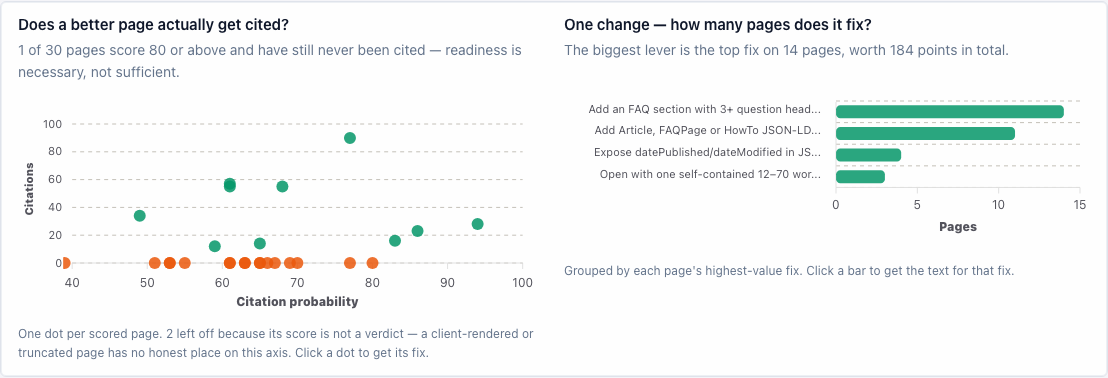
- Not a ranking prediction. It says nothing about where Google will place the page, and nothing about whether an engine will choose it. Readability is necessary, not sufficient — the screen makes this point against itself, counting the pages that score 80 or above and have still never been cited.
- Not a judgement of your writing. Nothing here reads your argument or your offer.
- Not always a verdict about the page at all. Where the crawl met a client-rendered shell, or a document too large to read past its first 512 KB, the row carries a Not a verdict badge. A client-rendered page's score is what an answer engine reading the HTML gets — not what a visitor sees. That gap is itself the finding.
A page the crawler could not fetch scores zero. A page an engine cannot open cannot be cited, whatever its markup says.
The seven signals
The weights add up to 100, and most signals award partial credit rather than pass/fail.
Answer-shaped opening paragraph — 18 points. The first substantive paragraph on the page, ignoring navigation, cookie prompts and pipe-separated link strips. It counts as answer-shaped when it runs roughly 12 to 70 words and is a real sentence. This carries the largest single weight because it is the block most often lifted verbatim: an engine that has to read four paragraphs before it reaches your claim usually quotes whoever put theirs first. An opening that exists but is not answer-shaped earns about a third of the points.
Content JSON-LD schema — 16 points. Whether the page declares itself as content an engine can quote: Article, BlogPosting, TechArticle, FAQPage, QAPage, HowTo and their siblings. Organization, WebSite, WebPage, Product or Breadcrumb markup on its own earns 40% of the weight — it describes the site, not the answer.
Question-and-answer block — 14 points. FAQPage or QAPage markup backed by at least two visible question headings scores in full. Schema without the visible headings scores 80%; three or more question headings with no schema, 60%; one or two, 30%. Both halves matter — the schema tells an engine what the block is, the visible text is what it actually quotes.
Clean heading structure — 14 points. Exactly one H1, at least two H2 sections, and no skipped levels. Headings are how a machine finds where an answer starts and stops. The three conditions score separately, so a page that gets one of them right still earns part of the weight.
Enough substance to quote — 14 points. Visible words on the page. 1,200 or more earns full credit, 600 three quarters, 300 half, 150 a quarter. Six hundred words is the substance line: below it a page rarely survives selection against a longer one covering the same ground.
Visible publish or update date — 12 points. A machine-readable date: datePublished or dateModified in JSON-LD, an article:published_time meta tag, or a <time datetime="…"> element. Dated within the last year scores in full, up to three years half, older than that a quarter, and no readable date at all scores nothing. Note that an old date still beats no date — an engine that cannot tell how old a page is treats that uncertainty as risk.
Lists and comparison tables — 12 points. Measured as density per 1,000 words, with tables counting double, so a long page cannot coast on a single bullet list. Extractable blocks are what get quoted; prose gets summarised, and a summary is where your specifics go missing.
Reading the screen
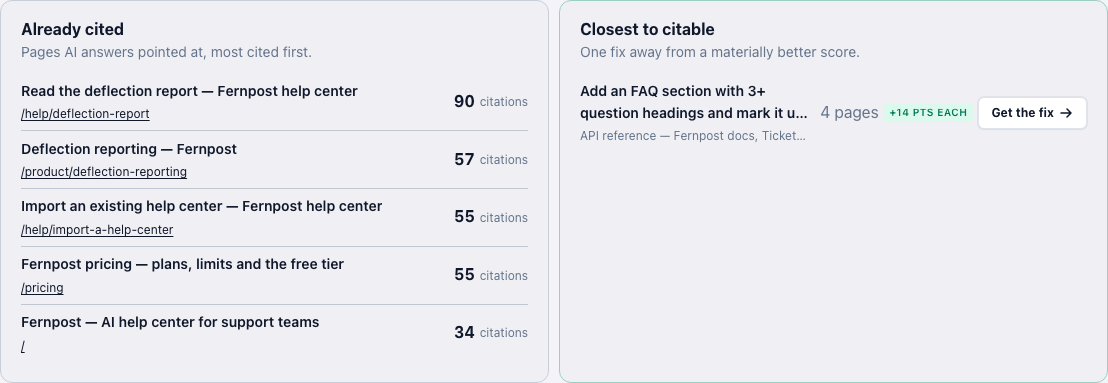
Already cited lists the pages AI answers have actually pointed at, most cited first. The same evidence sits in the table's Citations and Last cited columns, and the Cited only filter narrows the table to them. This is the shortest answer to "is any of this working".
Closest to citable is the working queue. It ranks pages by their potential — the score the page would reach after its single highest-value fix, shown on the row as Up to 74 after the fix. The What the page is missing column names that fix. Sorting the whole table by Closest to citable turns the inventory into a to-do list ordered by points recoverable rather than by your own sense of which page matters.
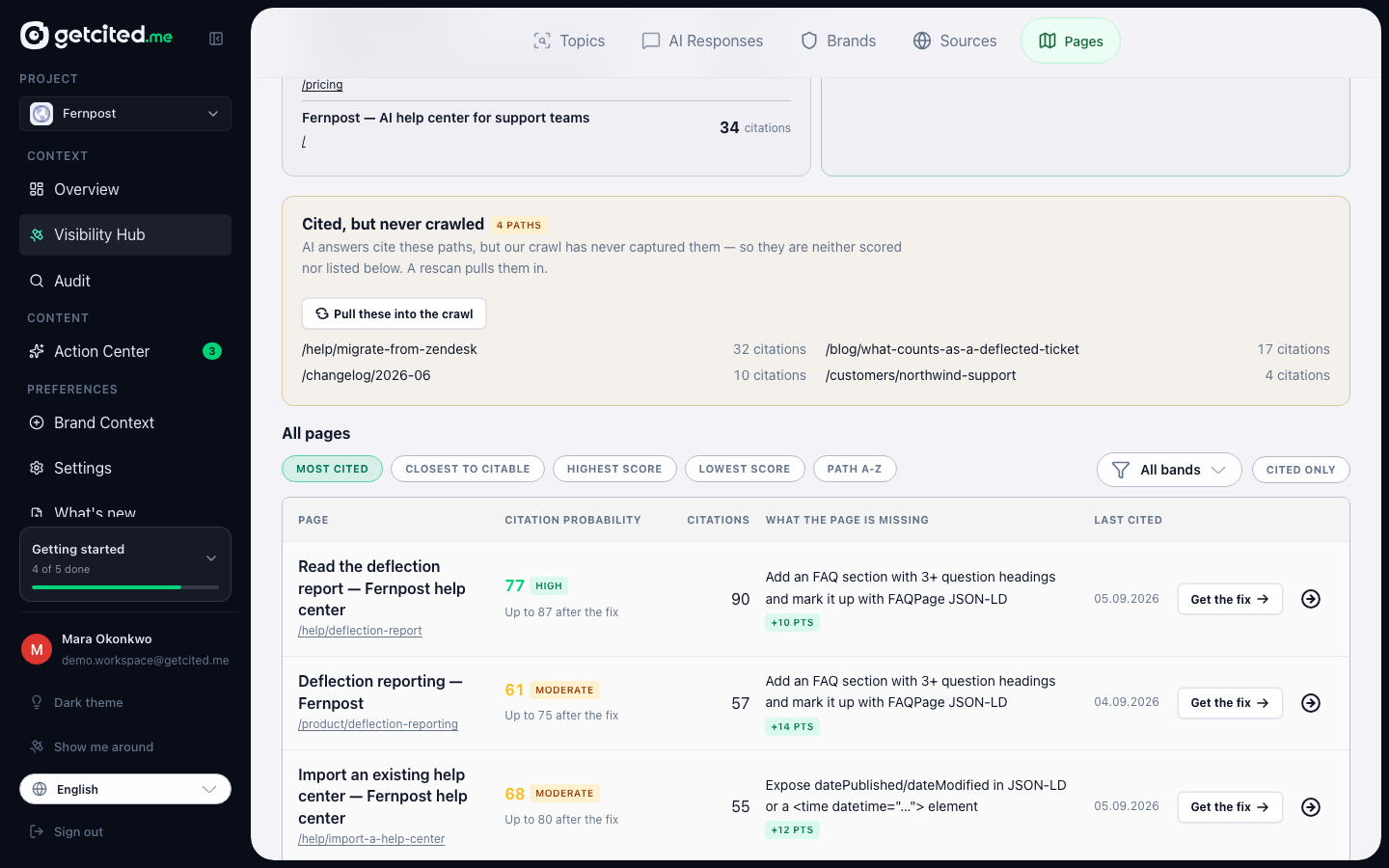
Cited, but never crawled is the panel worth checking first if it appears. These are paths that AI answers cite and the crawl has never captured, so they are neither scored nor listed below. A rescan pulls them in.
In Google appears only when this site has Search Console connected, and it answers a different question from the rest of the table: not whether AI should cite the page, but whether Google has the page at all. A page that is not in the index cannot be retrieved by anything reading Google, so a low score is not the first thing to fix on that row. The tag carries Google's own verdict — indexed, not crawled yet, crawled but not indexed, blocked, or a fetch that failed — and the line under it is the date Google last fetched the page, in Google's own words. Hover the tag for the full explanation.
Two things this column deliberately does not do. It does not claim your page changed after Google last read it: nothing here records when a page's content moved, so that sentence would be a guess. And it offers no button to request indexing, because no such button exists outside Search Console's own interface, where it is rate-limited to about ten pages a day and frequently refuses outright.
One thing to know about the crawl: a scan that gets throttled or times out mid-run does not delete the pages it never reached. Pages the crawl did reach always win, and pages whose fetch failed for a network reason are carried over from the previous inventory exactly as they were. A completed crawl still drops a page it looked for and genuinely did not find — an inventory that never forgets is worse than one that occasionally lags.
What "Get the fix" gives you
Not a new article. For each signal the page is missing, the finished text for that page:
- the opening paragraph, written to replace the one an engine currently reads first;
- the FAQ section, with the questions taken from this page, plus the FAQPage JSON-LD that marks it up;
- the Article or FAQPage JSON-LD, filled with this page's own title, description and URL;
- the corrected heading outline — your own headings, relevelled, plus any H2 section the page still needs;
- a table or list reorganised out of prose already on the page;
- a visible date and the JSON-LD that carries it;
- section briefs for the material a thin page is missing, which are briefs rather than finished prose, each saying what its section has to cover.
Every block has Copy and Download, and each one tells you where on the page it goes. The text is written in the page's own language — read off the page itself, falling back to your site's primary language — because it is going onto that page.
Two rules make the output worth pasting.
It is grounded in your page, or it is refused. Each fix is built from a fresh read of the live document, not from stored counts. If that document cannot be read — a bot check, a client-rendered shell, a body too thin to quote, a URL that is not HTML — the request is refused with the reason, and nothing is spent. We do not work around a bot check, and we do not fall back to a template with your brand name dropped into it.
Anything we do not hold comes back as a blank. A fact that is not on the page becomes a labelled slot for you to fill, never an invented figure. The same rule drops a generated block whose text came back carrying a number that appears nowhere on your page, and tells you it was dropped.
Three of the seven signals never call a model at all: schema, dates and heading levels are assembled from your page's own values. A page missing only those gets its full set of fixes for free, with no quota spent. Reopening a page you have already generated is also free — the plan is kept per page and regenerated only when a rescan finds the page has changed.
Why upgrading a page beats publishing a new one
A page already on your site has whatever standing it has accumulated: it is indexed, it has a history, and in the best case Pages can already show you an AI answer that cited it. A new page starts from nothing on every one of those.
The seven signals are also, without exception, changes to markup and structure on a page you control. There is no third party to persuade and nothing to wait for. When a page an engine already reads is missing a date and an FAQ block, adding them is the shortest distance between a score on this screen and a citation in a real answer.
That said, keep the earlier caveat in view: a well-formed page is a page that can be cited, not one that will be. Pages is the half of the problem you own outright. The other half is covered in Citation targets.
Plan limits
- Pages crawled and scored per site: 80 on Launch, 300 on Growth, 1,000 on Scale. Past the cap the crawl stops, and pages it did not reach simply are not in the inventory.
- Page rewrites per month: 5 on Launch, 60 on Growth, 200 on Scale. Only a generation spends a slot — a refused page, a reused plan and a fix assembled without a model call all cost nothing.
- Two rewrites a minute per site, on every plan. If you hit that, wait a moment and try again.
What to read next
- Citation targets — the third-party pages engines read, and how to get into them.
- Action Center — where drafts, briefs and replies are managed.
- Reading your AI answers — how a citation is recorded in the first place.