An AI answer is not written from memory. The engine reads a handful of pages, then assembles a reply out of what it found there. Change what it reads and you change what it says.
That reframes the whole problem. The useful question is not "what is my visibility score" — it is which pages feed the answers in my market, and how do I get into them. The Sources tab of Visibility Hub, headed Research Sources, is the list of those pages.
What the list actually contains
Every tracked answer we analyse records the URLs the engine leaned on. Sources aggregates them over a time window you choose, and ranks them.
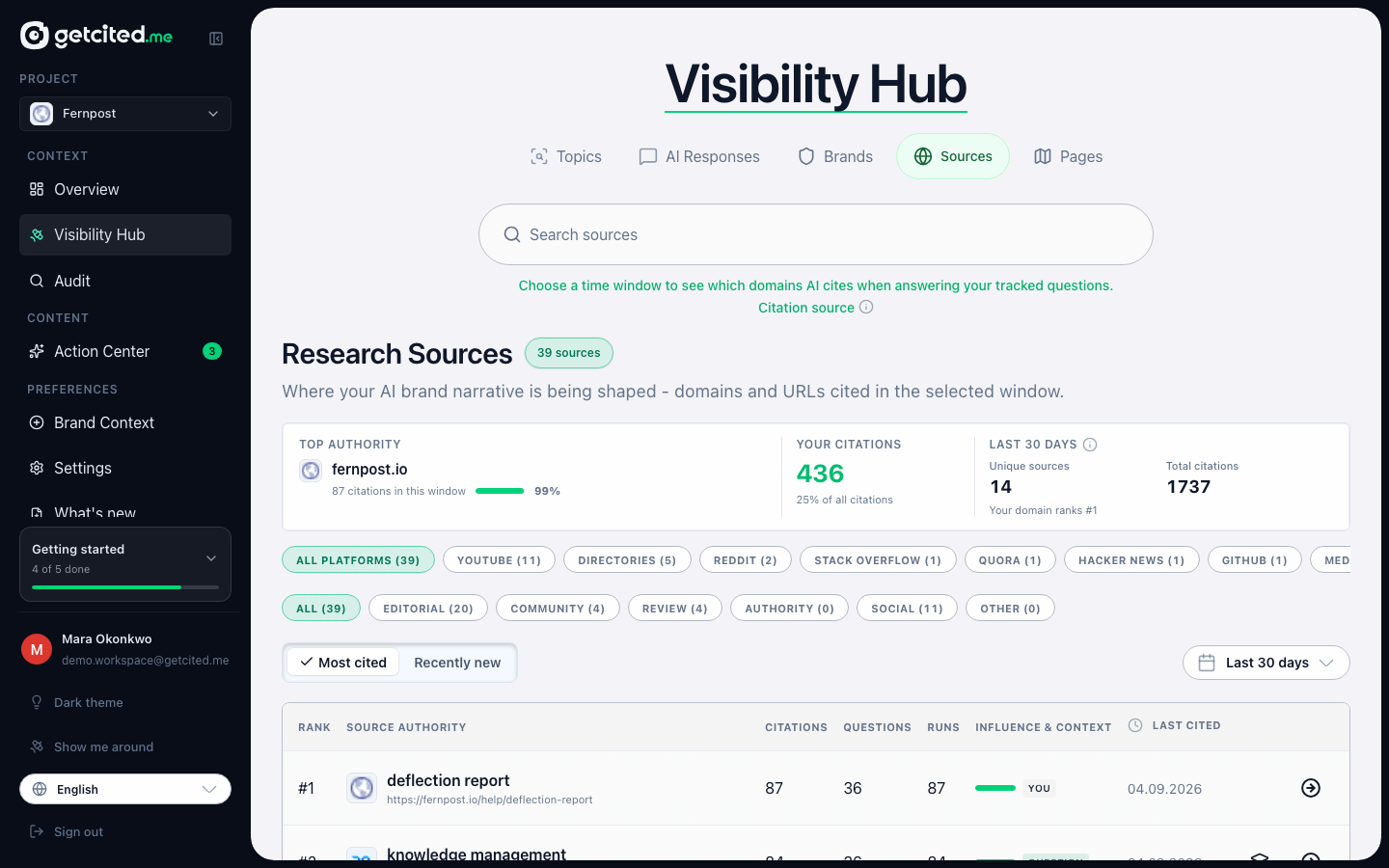
Each row is one source, with:
- Citations — how many times it was cited in the window.
- Questions — how many distinct tracked questions it turned up for. Usually the more important of the two: a page cited once across nine questions is shaping more of your market than a page cited nine times for one.
- Runs — how many individual answers it appeared in.
- Influence & context — an influence bar weighted toward breadth rather than volume (roughly 60% coverage across your tracked questions, 40% how heavily it is cited relative to the top source in the window), plus a tag saying whose page it is: You, Comp for a saved competitor's domain, or Question for a third party.
- Last cited, and an action.
Read the top of the list as the reading list your customers' AI assistants are working from. The panel above the table tells you where your own domain ranks in it, which is a blunter number than any score: it is your standing among the sources, not among the brands.
How a target is classified
Two layers, because they answer different questions.
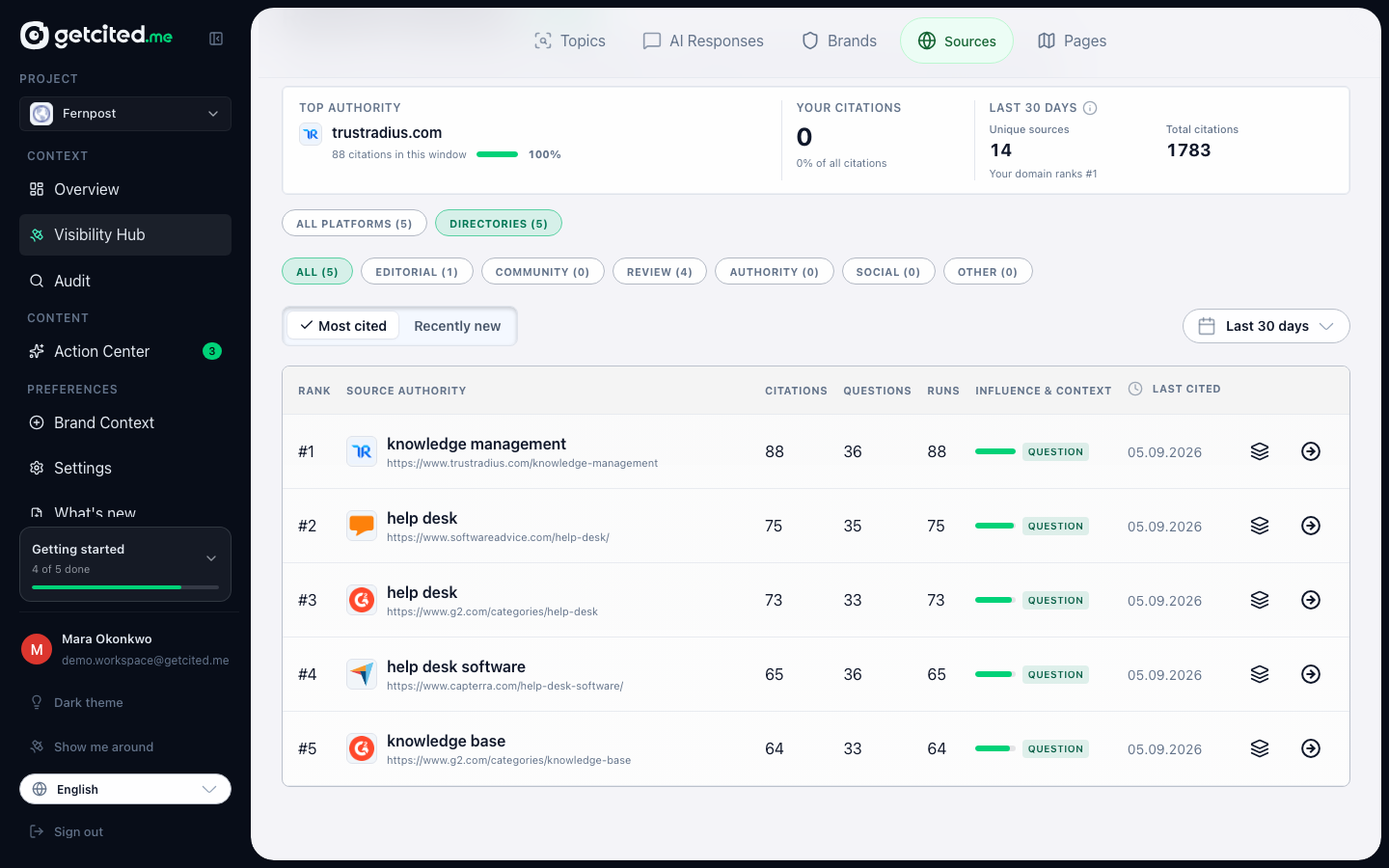
The category chips — Community, Review, Editorial, Authority, Social, Other — are a coarse filter over the domain. Reddit, Stack Overflow, Stack Exchange and Hacker News are Community. G2, Capterra, Trustpilot, Software Advice and GetApp are Review. YouTube, X, LinkedIn, Facebook, Instagram, TikTok, Threads and Pinterest are Social. Anything on .edu, .gov or .gov.uk is Authority. Everything else falls to Editorial, which is where most of the open web lands.
The platform filter is the one that decides what you can do about a row. It recognises Reddit, Stack Overflow, Quora, Hacker News, GitHub, Medium, Dev.to, Hashnode, Substack, WordPress, YouTube and a maintained list of directories — Clutch, GoodFirms, DesignRush, The Manifest, Sortlist, UpCity, Expertise.com, TechBehemoths, G2, Capterra, GetApp, Software Advice, TrustRadius, SaaSworthy, SoftwareSuggest, SourceForge, Slashdot, AlternativeTo, Product Hunt, Crunchbase and Trustpilot, plus the WordPress plugin directory. Anything else is Other.
Two details are worth knowing, because they explain rows that look inconsistent:
- The same host can land in different platforms depending on the path. A
wordpress.orgsupport thread is a community target; awordpress.orgplugin page is a directory listing. - A citation that names only a domain, with no page behind it, gets no action. There is no thread to reply to, no listing to claim and no author to write to. Those rows still count in the totals — they are real citations — but they are dead ends as targets, and the product says so rather than offering you a button that goes nowhere.
The entry route for each kind
Every actionable row carries one action, chosen by what kind of page it is.
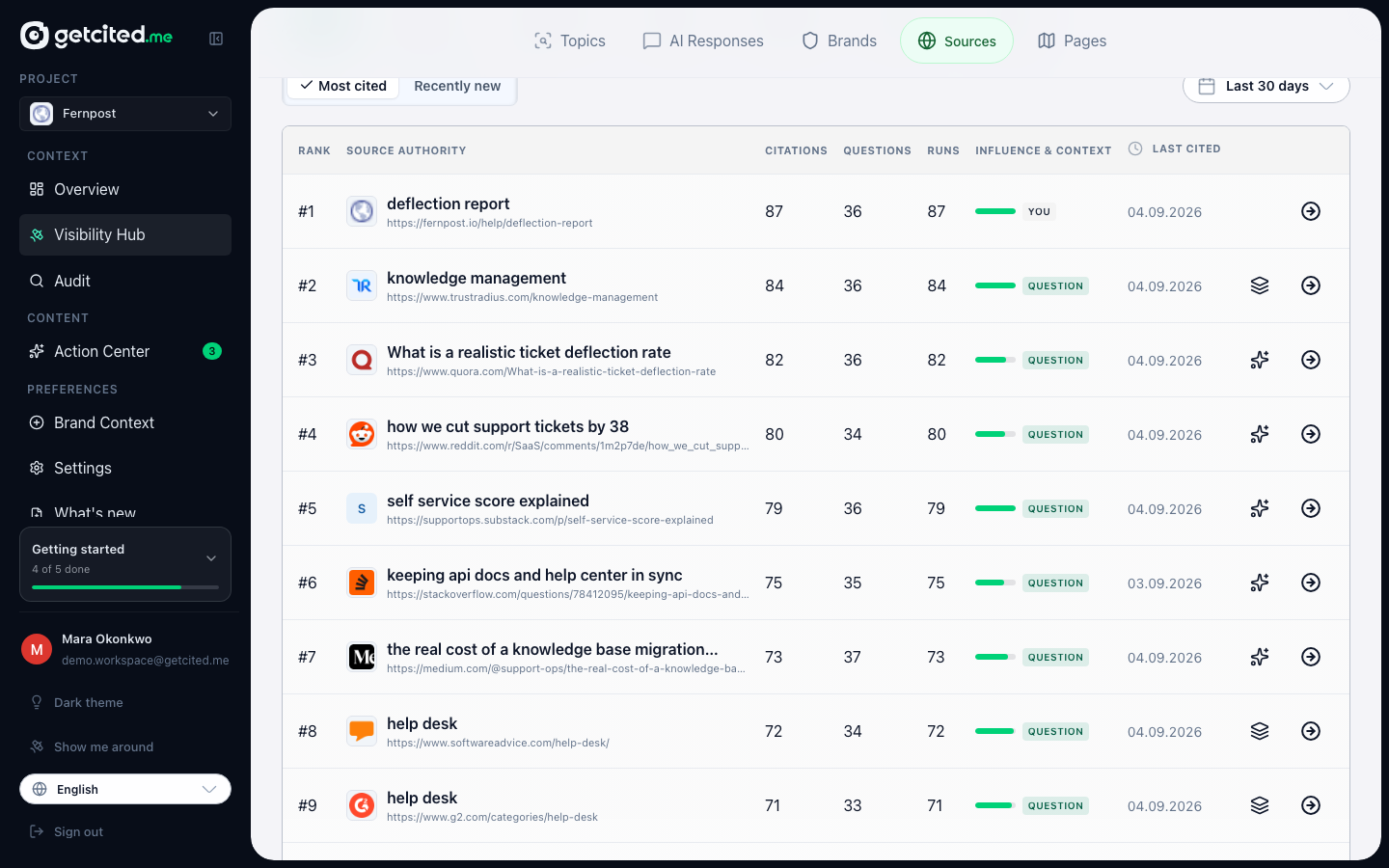
Community reply — Reddit, Stack Overflow, Quora, Hacker News, WordPress support threads. Opens the community workflow in Action Center, where the thread is checked and a reply is drafted against it.
Get listed — any directory or review platform. Opens the Directory Desk: what the model actually takes from that platform in your answers, a submission pack, and a check on a profile you have already published.
Pitch the video creator — YouTube. Opens the YouTube Desk, described below.
Write response article — Medium, Dev.to, Hashnode, Substack. These are publishing platforms rather than conversations; the route is a piece of your own, sent into the content flow.
Write comparison brief — a page that ranks a competitor, or a competitor-owned property. Asking a rival to add you to their own marketing page is not outreach, so the route is a comparison of your own instead.
Draft GitHub comment — a GitHub issue. This one is not built yet, and the row says so: open the issue manually for now.
Pitch the author — any other third-party page with a real path. Opens the Page Pitch Desk.
The three desks
The Directory Desk opens on one platform and starts with the evidence: how many of your answers read it, which tracked questions those answers came from, and which brands the model named after reading it. It then gives you a submission pack — tagline, short, medium and full descriptions, services, audience and differentiation — written in your site's language and already cut to that platform's field limits, so each field goes straight into the form. Where a platform moderates in English you get both versions, with the one the form takes marked.
It also checks a profile you have already published. Paste the profile URL, and the page is read and compared against your canonical brand facts — name, website, services, geography — field by field. It never posts anything to the platform, and a profile it cannot read comes back as "no verdict" with the facts listed for you to check by hand, not as a pass.
The Page Pitch Desk handles the long tail: an ordinary third-party page that the models keep reading. It opens with how many of your answers read that page and in how many of them you were named — the headline is different when the answer is none — then writes a short message: subject, body, the claims the recipient can verify for themselves, and the single ask.
Two things about it are deliberate. The message is written in the page's language, not yours, because a stranger has to read it. And the contact route is only ever one the page itself publishes. If there is no published address, the desk says so and tells you where to look — a byline, an About page, the site's own social profiles — rather than guessing an address.
The YouTube Desk is text only. GetCited.me does not make videos, and nothing here implies otherwise. It lists the cited videos, works out whose channel each is on, and produces a text pack whose contents depend on the answer:
- Your own video — a rewritten description, a chapter plan, a summary to pin as a comment, and a warning if the caption track is missing. The chapter plan is titles only, with no timestamps: we have not watched the video, and inventing times would send viewers to the wrong second. Watch it once and write the real start times in yourself.
- A competitor's video — a plan for a piece of your own, to publish on a page you control.
- Anyone else's — a pitch to the creator, plus a public-comment fallback that discloses the affiliation in its first sentence.
Ownership can be a name match rather than a confirmed fact, and the desk marks it as a guess when it is one; you can confirm or reject it, or set your channel once in Settings.
When a platform feeds your market and never names you
This is the case Sources exists for. The desk states it plainly, in one of three forms:
- The model reads this platform for N of your answers. Your brand is not among the names it takes from there. — You are absent from a source that is actively shaping answers in your category. Getting listed is the whole fix, and the submission pack is right there.
- The model already names you in N of the answers it reads off this platform — and your listing is not there. — You are being recommended in spite of the source, not because of it. This is usually the cheapest win on the screen.
- You are already on this platform, and the model names you in N of M answers that read it. — The listing exists and is doing work. Check it against your current facts with the profile check; a listing that has drifted out of date is worth more attention than a new one somewhere else.
For a review platform, "get listed" also means the listing has to be worth reading once it exists. The engine quotes what the page says about you, not the fact that you have a page.
What this screen will not do
- It does not work around bot checks. A page that answers with a bot check is reported as unread. The pitch is still written, from the answers that cite the page, and you are told to read the page yourself before sending.
- It does not invent contact details. No published route means no address, and the desk says so.
- It does not treat "unavailable" as "absent". YouTube caption status, for example, can be unreadable rather than missing; the panel distinguishes the two instead of telling you to fix something that may already be fine.
- It does not post anything anywhere. Every desk produces text for you to send, submit or publish. Nothing is dispatched on your behalf.
- It cannot act on a bare domain. See above — a citation with no page behind it has no entry route.
A reasonable way to work through it
- Set the window to a period with real data in it and sort by Most cited.
- Ignore your own rows and your competitors' own sites for a moment. Look at the third-party pages — those are the ones you can influence.
- Find the highest row where the Questions count is large and you are not named. That is a source shaping many of your answers without you in it.
- Take its action. Directory rows are usually the fastest to close; community threads pay off next; author pitches are the slowest and the most durable.
- After anything lands, run tracking again. A source only counts once an answer actually reads it.
What to read next
- Your pages — the same problem on the site you own.
- Reading your AI answers — where the citations on this screen come from.
- Competitors and brands — who else those sources are recommending.